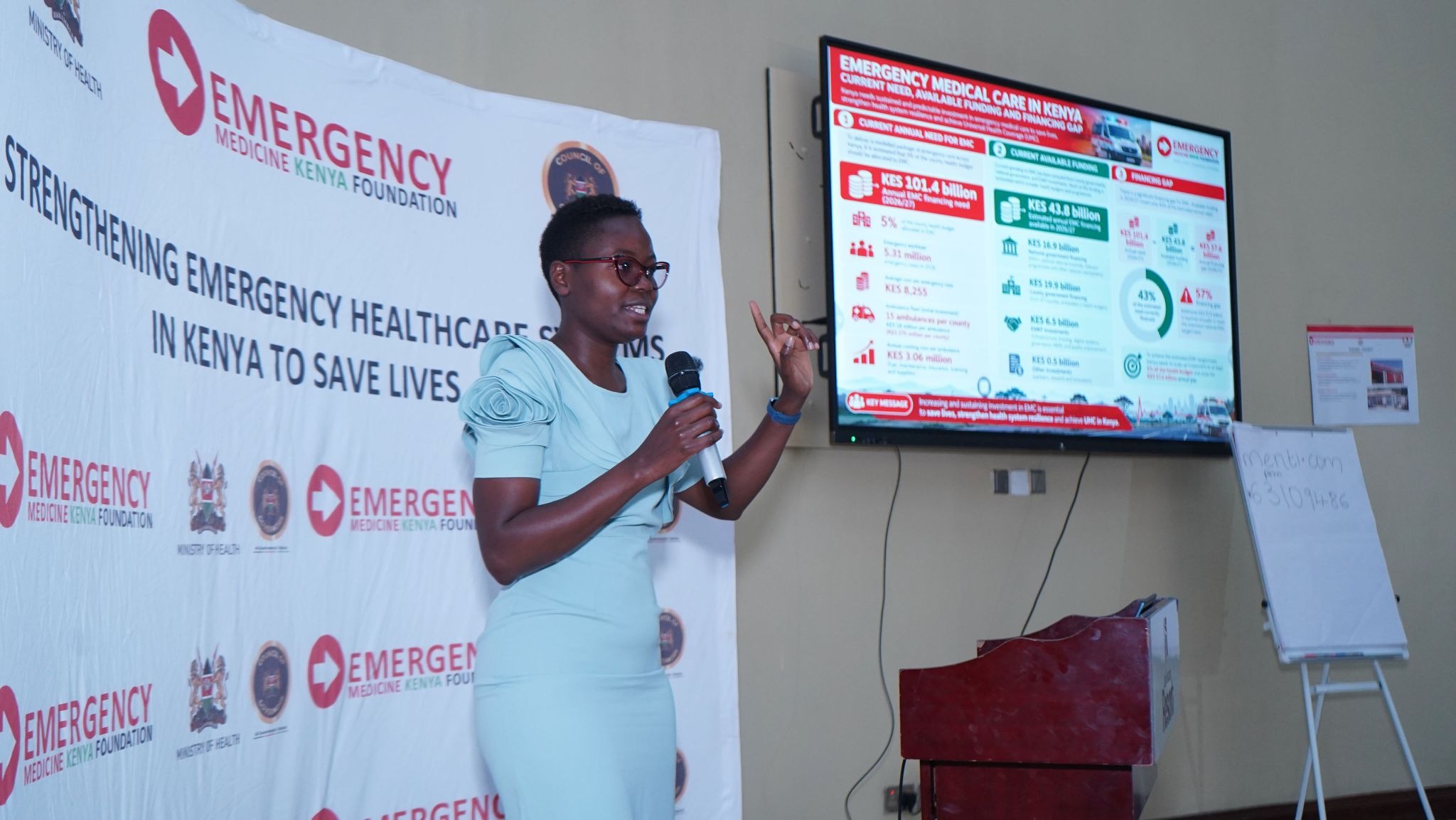
Financing emergency care means financing faster, more reliable lifesaving care when patients need it most.
Kenya has made important progress in establishing policies and frameworks for emergency medical care. But policies alone do not dispatch an ambulance, keep an Emergency Care Centre running, maintain lifesaving equipment, or ensure trained teams are available around the clock.7
Turning these commitments into services patients can rely on requires clear, adequate and predictable financing.
This challenge was central to the County Leadership Emergency Care Conference 2026, convened by the Emergency Medicine Kenya Foundation (EMKF) in Naivasha. The conference brought together county health leaders, emergency medical care teams and partners to address a practical question raised by county governments:
How do we turn our Emergency Medical Care policies into services that patients can rely on?
Across two days of practical sessions and county peer learning, participants explored how to cost emergency medical care services, identify financing gaps, use service data to guide investment and improve reimbursement for care already provided. County experiences also demonstrated what coordinated emergency services can achieve—and what it takes to sustain them.
Understanding what emergency care actually costs
A major challenge highlighted on Day 1 was that county budgets often make the true cost of emergency medical care difficult to see.
The resources required to run an emergency care system may be distributed across multiple budget lines and departments. Ambulance fuel may sit under one budget, vehicle maintenance under another and staffing elsewhere, while medicines, equipment, communications and technology may each be financed separately.
As a result, counties may provide emergency services without a clear picture of the total resources required to sustain them.
This makes it difficult to answer fundamental questions: What does our emergency medical care service cost? What is currently funded? Where are the gaps? And what additional investment is required to deliver the level of service patients need?
Through practical sessions, county teams costed their emergency medical care priorities, identified financing gaps, and explored how to reflect these needs in county budgets.
Making these costs explicit provides a foundation for adequate funding, clearer spending priorities and sustained service delivery.

Using service data to guide investment
Once counties understand their costs, they need evidence to explain where investment is needed and assess what it delivers.
Emergency medical care teams therefore need to be involved early in county planning and budgeting processes, using service data to demonstrate needs and inform investment priorities.
Data can show how many emergency patients are treated, how many ambulance incidents are managed, how quickly patients are reached, and where gaps are affecting patient care.
This helps county teams move beyond general requests for additional funding and make a clearer case for investment by demonstrating the services they deliver, what those services cost, the populations they serve and the gaps that prevent reliable service delivery.
The same data can help counties track whether investment improves service availability, response times and quality of care.

What coordinated ambulance services can deliver
On Day 2, counties shared practical experiences of strengthening emergency care services, demonstrating how investment in coordinated systems can improve service delivery.
Mombasa County demonstrated the value of coordinated ambulance services. Through its 24/7 ambulance dispatch centre, powered by Ambulensi, the county reported reducing ambulance response times from approximately 1–2 hours to 25 minutes.
This improvement illustrates what coordinated ambulance services can achieve when dispatchers, ambulance crews, communication systems and healthcare facilities work together.
It also highlights an important financing lesson: purchasing ambulances is not enough. Counties must fund the trained personnel, equipment, technology, fuel, maintenance and day-to-day operations needed to keep ambulance services running.
Financing an ambulance is not the same as financing an ambulance service.
The conference also explored coordination between the 922 National Ambulance Dispatch Centre and county ambulance services. The national system provides an important opportunity to connect people experiencing emergencies with coordinated ambulance response. Realising this potential requires sustained investment in county ambulance services, trained personnel, dispatch operations and effective coordination between national and county systems.

Securing reimbursement for emergency care already provided
Alongside budgeting for service delivery, counties need effective processes to secure reimbursement for eligible emergency care.
During sessions on the Emergency, Chronic and Critical Illness Fund (ECCIF), the team from Nyeri County Referral Hospital demonstrated how emergency cases are identified, activated and submitted through the Social Health Authority (SHA) portal. The team reported that strengthening these processes had helped the hospital increase revenue from emergency cases previously treated but not reimbursed.

Nyeri’s experience highlights an important financing opportunity for county Emergency Care Centres. Emergency patients must receive timely treatment, regardless of their immediate ability to pay. Under ECCIF, eligible emergency services can be financed through established reimbursement mechanisms.
However, when eligible emergency cases are not correctly identified, documented, activated and submitted for reimbursement, hospitals risk missing payments for care already provided.
SHA representatives also shared practical guidance on ECCIF documentation, case activation and claims submission.

Strengthening these processes, including tracking claims through to payment, can help hospitals recover eligible costs and support continued service delivery.
Reimbursement is not a substitute for adequate county budget allocations. Both are needed to sustain reliable emergency care.
From emergency care policies to funded services
Across both days, county discussions reinforced that sustainable emergency medical care requires financing the entire patient pathway—from recognising an emergency and activating help to coordinated ambulance response and timely treatment at an appropriate facility.
Each stage depends on people, equipment and operational systems that must be funded consistently.
The County Leadership Emergency Care Conference builds on EMKF’s work with national and county governments to strengthen emergency healthcare systems that save lives. County teams identified practical priorities for taking this work forward:
- Determine the true cost of emergency medical care services.
- Make emergency medical care costs explicit in county budgets and allocate adequate funding to sustain services.
- Use service data to demonstrate needs, guide investment and track performance.
- Improve ECCIF documentation, claims submission and reimbursement processes.
- Address staffing and operational gaps that continue to delay care.
These priorities reinforce a central lesson from the conference: emergency care financing must be considered from the beginning of service planning, not after services have been established.
For county governments, the next step is to translate costed emergency care priorities into funded budgets, strengthen reimbursement processes, and use service data to monitor whether investments improve care.
Emergency care policies create the mandate. Financing makes reliable service delivery possible.
Ultimately, progress is measured not simply by whether emergency care is included in a policy or budget, but by whether people experiencing emergencies can access timely, quality care when they need it most.
Explore highlights from the conference
Click the MEDIA button below to browse photos, watch videos, and view presentations from the two-day conference